DropQuery#
- class skactiveml.pool.DropQuery(dropout_rate=0.75, n_dropout_samples=5, cluster_algo=<class 'sklearn.cluster._kmeans.KMeans'>, cluster_algo_dict=None, n_cluster_param_name='n_clusters', clf_embedding_flag_name=None, missing_label=nan, random_state=None, multilabel_aggregation_fn=<function mean>, disagreement_threshold=0.5, target_type='auto')[source]#
Bases:
SingleAnnotatorPoolQueryStrategyDropout Query (DropQuery)
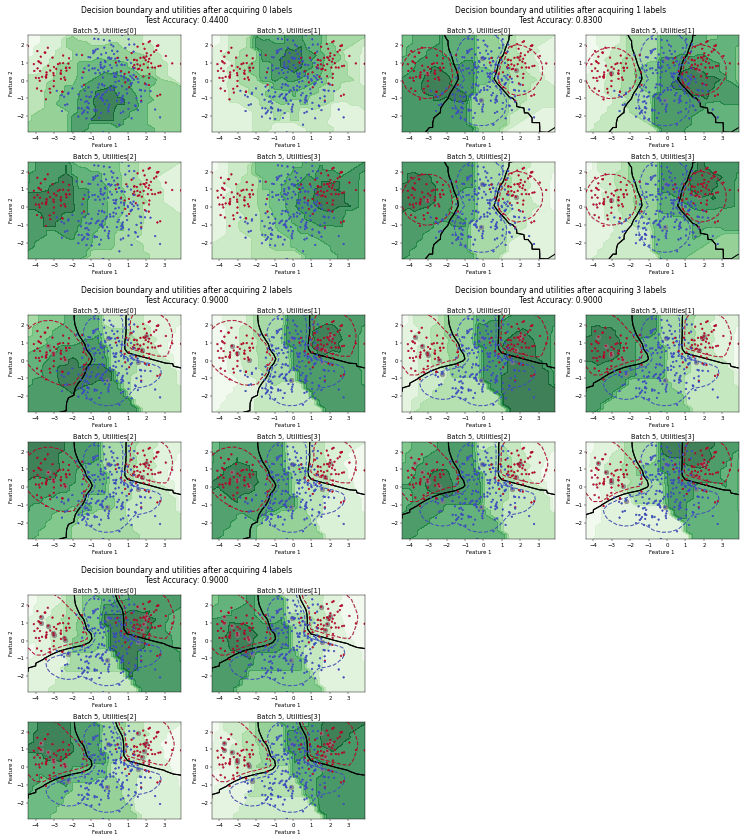
This class implements the query strategy Dropout Query (DropQuery) [1] that incorporates both uncertainty and sample diversity into every selected batch. For this purpose, unlabeled samples are filtered according to a disagreement-based measure via dropout such that only the unlabeled samples with a disagreement above a threshold are clustered for selecting the unlabeled samples nearest to the respective clusters.
DropQuery was proposed for single-output classification. Multi-label support in this implementation is an extension and not part of the original proposal in [1]. For resolved multi-label targets, the disagreement is counted per label output, i.e., the per-label score of the label output j is the number of the n_dropout_samples dropout predictions whose label j differs from the label j predicted without dropout, and is therefore an integer in [0, n_dropout_samples]. multilabel_aggregation_fn reduces these per-label counts along the label axis, and the reduced count is divided by n_dropout_samples to obtain the disagreement rate compared with disagreement_threshold. This per-output decomposition ignores correlations between label outputs, i.e., a dropout prediction flipping several labels jointly is indistinguishable from independent flips of the same labels.
- Parameters:
- dropout_ratefloat, default=0.75
Dropout rate used to generate samples.
- n_dropout_samplesint, default=3
Number of dropout samples.
- cluster_algoClusterMixin.__class__, default=KMeans
The cluster algorithm to be used. It must implement a fit_transform method, which takes samples X as inputs, e.g., sklearn.clustering.KMeans and sklearn.clustering.MiniBatchKMeans.
- cluster_algo_dictdict, default=None
The parameters passed to the clustering algorithm cluster_algo, excluding the parameter for the number of clusters.
- n_cluster_param_namestring, default=”n_clusters”
The name of the parameter for the number of clusters.
- clf_embedding_flag_namedict or str or None, default=None
Flag, which is passed to the predict method for getting the (learned) sample representations.
If clf_embedding_flag_name is None and predict returns only one output, the input samples X are used.
If clf_embedding_flag_name is None and predict returns two outputs, (y_pred, embeddings) are expected as outputs.
If isinstance(clf_embedding_name, str), we call:
clf.predict(X, **{clf_embedding_flag_name: True})
and expect (y_pred, embeddings) as output.
If isinstance(clf_embedding_name, dict), we call:
clf.predict(X, **clf_embedding_flag_name)
and expect (y_pred, embeddings) as output.
- missing_labelscalar or string or np.nan or None, default=np.nan
Value to represent a missing label.
- random_stateNone or int or np.random.RandomState, default=None
The random state to use.
- multilabel_aggregation_fncallable, default=np.mean
Callable reducing the per-label disagreement counts of one sample to one count. It is only used for resolved multi-label classification targets. It is called with the per-label scores of shape (n_samples, n_outputs) and the label axis passed as the axis keyword argument, and must return one score per sample within the range of that sample’s per-label scores, e.g. np.mean, np.average, np.median, np.min, np.max, or a quantile. np.sum is not supported, because its result grows with the number of label outputs. Only the callability of the reduction is validated at runtime, so a violating reduction silently changes the acquisition scale.
- disagreement_thresholdfloat, default=0.5
Threshold used to filter candidate samples based on their disagreement score. For multi-label targets, the per-label disagreement counts are first reduced by multilabel_aggregation_fn before being divided by n_dropout_samples. A scale-preserving reduction therefore keeps the resulting rate in [0, 1], but the multi-label path does not restrict the threshold to that interval.
- target_type“auto” or “single-output” or “multi-label”, default=”auto”
Declared target type. The strategy supports single-output and multi-label classification. A fitted classifier’s target specification is authoritative when available.
References
Methods
query(X, y, clf[, fit_clf, sample_weight, ...])Query the next samples to be labeled.
Get metadata routing of this object.
get_params([deep])Get parameters for this estimator.
set_params(**params)Set the parameters of this estimator.
- DropQuery.query(X, y, clf, fit_clf=True, sample_weight=None, candidates=None, batch_size=1, return_utilities=False)[source]#
Query the next samples to be labeled.
- Parameters:
- Xarray-like of shape (n_samples, n_features)
Training data set, usually complete, i.e. including the labeled and unlabeled samples.
- yarray-like of shape (n_samples,) or (n_samples, n_outputs)
Labels of the training data set (possibly including unlabeled ones indicated by self.missing_label). For multi-label targets, a row y[i] must either contain only observed labels or only missing_label values, i.e., no mixing within a row.
- clfskactiveml.base.SkactivemlClassifier
Classifier implementing the methods fit and predict.
- fit_clfbool, default=True
Defines whether the classifier clf should be fitted on X, y, and sample_weight.
- sample_weightarray-like of shape (n_samples,) or (n_samples, n_outputs), default=None
Weights of training samples in X. For two-dimensional y, one weight per sample is supported. Per-target weights are forwarded to clf.fit without additional validation and require estimator support.
- candidatesNone or array-like of shape (n_candidates,) of type int, default=None
If candidates is None, the unlabeled samples from (X,y) are considered as candidates.
If candidates is of shape (n_candidates,) and of type int, candidates is considered as the indices of the samples in (X,y).
- batch_sizeint, default=1
The number of samples to be selected in one AL cycle.
- return_utilitiesbool, default=False
If true, also return the utilities based on the query strategy.
- Returns:
- query_indicesnumpy.ndarray of shape (batch_size,)
The query indices indicate for which candidate sample a label is to be queried, e.g., query_indices[0] indicates the first selected sample. The indexing refers to the samples in X.
- utilitiesnumpy.ndarray of shape (batch_size, n_samples)
The utilities of samples after each selected sample of the batch, e.g., utilities[0] indicates the utilities used for selecting the first sample (with index query_indices[0]) of the batch. Utilities for labeled samples will be set to np.nan. The indexing refers to the samples in X.
- DropQuery.get_metadata_routing()#
Get metadata routing of this object.
Please check User Guide on how the routing mechanism works.
- Returns:
- routingMetadataRequest
A
MetadataRequestencapsulating routing information.
- DropQuery.get_params(deep=True)#
Get parameters for this estimator.
- Parameters:
- deepbool, default=True
If True, will return the parameters for this estimator and contained subobjects that are estimators.
- Returns:
- paramsdict
Parameter names mapped to their values.
- DropQuery.set_params(**params)#
Set the parameters of this estimator.
The method works on simple estimators as well as on nested objects (such as
Pipeline). The latter have parameters of the form<component>__<parameter>so that it’s possible to update each component of a nested object.- Parameters:
- **paramsdict
Estimator parameters.
- Returns:
- selfestimator instance
Estimator instance.