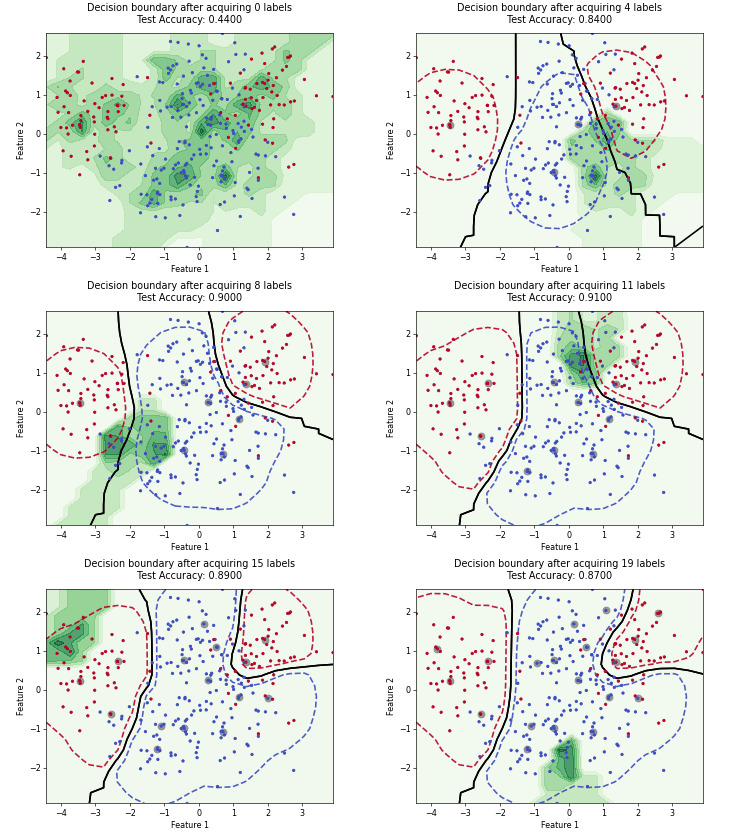
TypiClust#
- class skactiveml.pool.TypiClust(missing_label=nan, random_state=None, cluster_algo=<class 'sklearn.cluster._kmeans.KMeans'>, cluster_algo_dict=None, n_cluster_param_name='n_clusters', k=5, target_type='auto')[source]#
Bases:
SingleAnnotatorPoolQueryStrategyTypical Clustering (TypiClust)
This class implements the Typical Clustering (TypiClust) query strategy [1], which clusters embeddings of both labeled and unlabeled data with n_clusters=min(n_labeled_samples + batch_size, n_samples). Clusters containing labeled samples are covered. It then selects the most typical sample (highest local density / smallest mean kNN distance) from up to batch_size uncovered clusters, ensuring diversity while avoiding already represented regions. Originally, this query strategy was only proposed for classification tasks. Nevertheless, this implementation is task-agnostic such that it can handle class labels, numerical targets, and multilabel targets represented by a two-dimensional y. Clusters without eligible candidates are skipped. If no uncovered cluster remains, the batch is filled uniformly from the remaining candidates.
- Parameters:
- missing_labelscalar or string or np.nan or None, default=np.nan
Value to represent a missing label.
- random_stateNone or int or np.random.RandomState, default=None
The random state to use.
- cluster_algoClusterMixin.__class__, default=KMeans
The cluster algorithm to be used.
- cluster_algo_dictdict, optional (default=None)
The parameters passed to the clustering algorithm cluster_algo, excluding the parameter for the number of clusters.
- n_cluster_param_namestring, default=”n_clusters”
The name of the parameter for the number of clusters.
- kint, default=5
The number for k-nearest-neighbors for the computation of typicality.
- target_type“auto” or “single-output” or “multi-label”, default=”auto”
Declared target structure. Automatic resolution accepts only single-output targets. Multi-label targets must be declared explicitly.
References
[1]G. Hacohen, A. Dekel, and D. Weinshall. Active Learning on a Budget: Opposite Strategies Suit High and Low Budgets. In Int. Conf. Mach. Learn., pages 8175–8195, 2022.
Methods
query(X, y[, candidates, batch_size, ...])Determines for which candidate samples labels are to be queried.
Get metadata routing of this object.
get_params([deep])Get parameters for this estimator.
set_params(**params)Set the parameters of this estimator.
- TypiClust.query(X, y, candidates=None, batch_size=1, return_utilities=False)[source]#
Determines for which candidate samples labels are to be queried.
- Parameters:
- Xarray-like of shape (n_samples, n_features)
Training data set, usually complete, i.e., including the labeled and unlabeled samples.
- yarray-like of shape (n_samples,) or (n_samples, n_outputs)
Labels of the training data set (possibly including unlabeled ones indicated by self.missing_label). If y is two-dimensional, a row y[i] must either contain only observed labels or only missing_label values, i.e., no mixing within a row.
- candidatesNone or array-like of shape (n_candidates), dtype=int or array-like of shape (n_candidates, n_features), default=None
If candidates is None, the unlabeled samples from (X,y) are considered as candidates.
If candidates is of shape (n_candidates,) and of type int, candidates is considered as the indices of the samples in (X,y). Labeled candidates remain eligible and mark their clusters as covered.
Candidate samples passed directly with shape (n_candidates, n_features) are not supported because TypiClust requires a mapping to samples in X.
- batch_sizeint, default=1
The number of samples to be selected in one AL cycle.
- return_utilitiesbool, default=False
If True, also return the utilities based on the query strategy.
- Returns:
- query_indicesnumpy.ndarray of shape (batch_size)
The query indices indicate for which candidate sample a label is to be queried, e.g., query_indices[0] indicates the first selected sample. The indexing refers to the samples in X.
- utilitiesnumpy.ndarray of shape (batch_size, n_samples) or numpy.ndarray of shape (batch_size, n_candidates)
The utilities of samples after each selected sample of the batch, e.g., utilities[0] indicates the utilities used for selecting the first sample (with index query_indices[0]) of the batch. Utilities for samples outside the candidate set and samples already selected in the batch are set to np.nan. The indexing refers to the samples in X.
- TypiClust.get_metadata_routing()#
Get metadata routing of this object.
Please check User Guide on how the routing mechanism works.
- Returns:
- routingMetadataRequest
A
MetadataRequestencapsulating routing information.
- TypiClust.get_params(deep=True)#
Get parameters for this estimator.
- Parameters:
- deepbool, default=True
If True, will return the parameters for this estimator and contained subobjects that are estimators.
- Returns:
- paramsdict
Parameter names mapped to their values.
- TypiClust.set_params(**params)#
Set the parameters of this estimator.
The method works on simple estimators as well as on nested objects (such as
Pipeline). The latter have parameters of the form<component>__<parameter>so that it’s possible to update each component of a nested object.- Parameters:
- **paramsdict
Estimator parameters.
- Returns:
- selfestimator instance
Estimator instance.