PeriodicSampling#
- class skactiveml.stream.PeriodicSampling(budget=None, random_state=None)[source]#
Bases:
SingleAnnotatorStreamQueryStrategyPeriodic Sampling for Data Streams
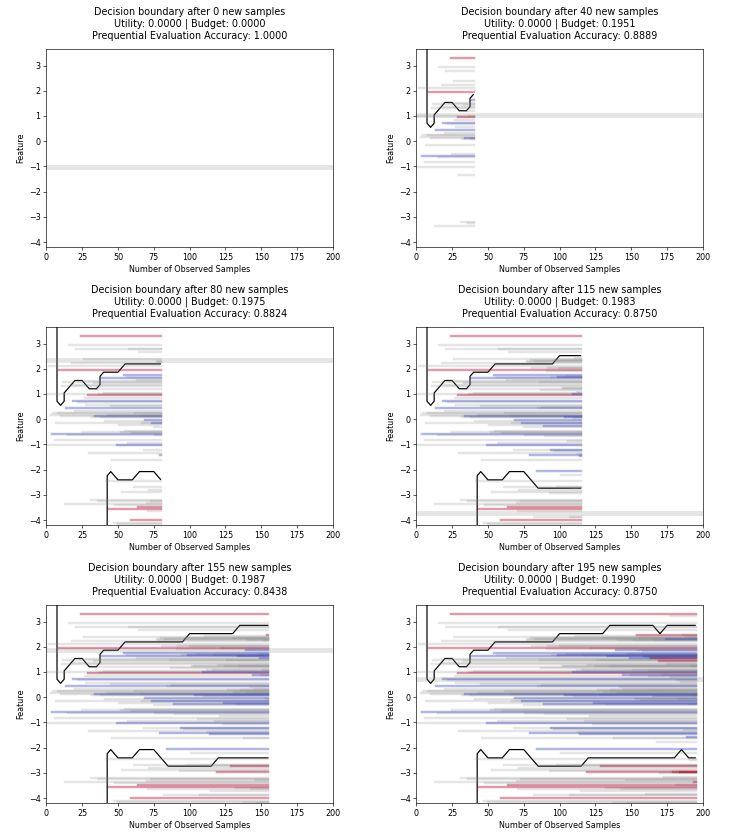
The PeriodicSampling strategy samples labels periodically. The length of that period is determined by the budget. For instance, a budget of 0.25 would result in querying every fourth sample. The main idea behind this query strategy is to exhaust a given budget as soon as it is available. Samples are queried regardless of their position in the feature space and without using information about the sample. Thus, it should only be used as a baseline strategy. Neither labels nor a model are consumed, so the strategy is task-agnostic and supports single-output and multi-label classification as well as regression.
- Parameters:
- budgetfloat, default=None
Specifies the ratio of samples which may be queried, with 0 < budget <= 1. If budget is None, the default budget 0.1 is used.
- random_stateint or RandomState instance or None, default=None
Controls the randomness of the estimator.
Methods
query(candidates[, return_utilities])Determines for which candidate samples labels are to be queried.
update(candidates, queried_indices[, ...])Updates the count for seen and queried labels.
Get metadata routing of this object.
get_params([deep])Get parameters for this estimator.
set_params(**params)Set the parameters of this estimator.
- PeriodicSampling.query(candidates, return_utilities=False)[source]#
Determines for which candidate samples labels are to be queried.
The query startegy determines the most useful samples in candidates, which can be acquired within the budgeting constraint specified by budget. Please note that, this method does not change the internal state of the query strategy. To adapt the query strategy to the selected candidates, use update(…).
- Parameters:
- candidates{array-like, sparse matrix} of shape (n_candidates, n_features)
The samples which may be queried. Sparse matrices are accepted only if they are supported by the base query strategy.
- return_utilitiesbool, default=False
If True, also return the utilities based on the query strategy.
- Returns:
- queried_indicesnp.ndarray of shape (n_queried_indices,)
The indices of samples in candidates whose labels are queried, with 0 <= queried_indices < n_candidates.
- utilitiesnp.ndarray of shape (n_candidates,)
The utilities based on the query strategy. Only provided if return_utilities is True.
- PeriodicSampling.update(candidates, queried_indices, budget_manager_param_dict=None)[source]#
Updates the count for seen and queried labels. This function should be used in conjunction with the query function.
- Parameters:
- candidates{array-like, sparse matrix} of shape (n_candidates, n_features)
The samples which may be queried. Sparse matrices are accepted only if they are supported by the base query strategy.
- queried_indicesarray-like of shape (n_queried_indices,)
The indices of samples in candidates whose labels are queried, with 0 <= queried_indices < n_candidates.
- budget_manager_param_dictIgnored
Not used, present here for API consistency by convention.
- Returns:
- selfSingleAnnotatorStreamQueryStrategy
The query strategy returns itself, after it is updated.
- PeriodicSampling.get_metadata_routing()#
Get metadata routing of this object.
Please check User Guide on how the routing mechanism works.
- Returns:
- routingMetadataRequest
A
MetadataRequestencapsulating routing information.
- PeriodicSampling.get_params(deep=True)#
Get parameters for this estimator.
- Parameters:
- deepbool, default=True
If True, will return the parameters for this estimator and contained subobjects that are estimators.
- Returns:
- paramsdict
Parameter names mapped to their values.
- PeriodicSampling.set_params(**params)#
Set the parameters of this estimator.
The method works on simple estimators as well as on nested objects (such as
Pipeline). The latter have parameters of the form<component>__<parameter>so that it’s possible to update each component of a nested object.- Parameters:
- **paramsdict
Estimator parameters.
- Returns:
- selfestimator instance
Estimator instance.