LabelCardinalityInconsistency#
- class skactiveml.pool.LabelCardinalityInconsistency(missing_label=nan, random_state=None, target_type='auto')[source]#
Bases:
SingleAnnotatorPoolQueryStrategyLabel Cardinality Inconsistency (LCI)
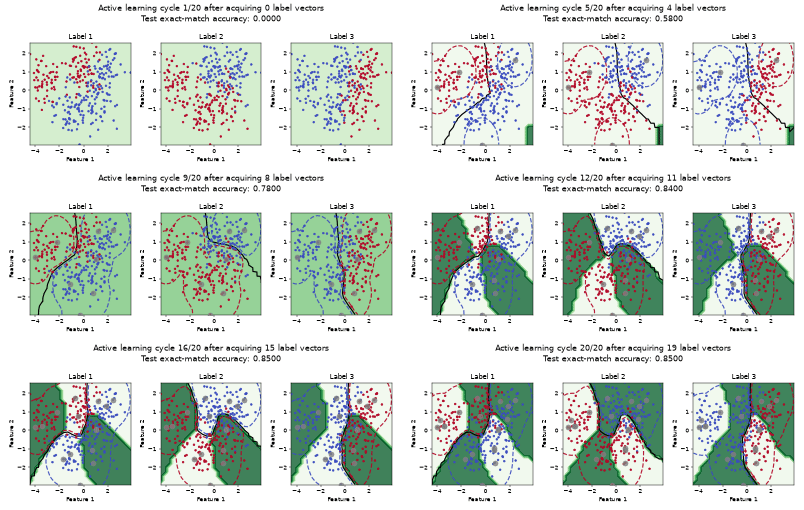
This class implements the query strategy Label Cardinality Inconsistency (LCI) [1] that selects samples based on the difference in label cardinality between the labeled pool and the predicted number of positive labels in the unlabeled pool. This strategy is multi-label-only: y must be two-dimensional and each row must be either fully labeled or fully unlabeled.
- Parameters:
- missing_labelscalar or string or np.nan or None, default=np.nan
Value to represent a missing label.
- random_stateint or RandomState instance or None, default=None
Controls the randomness of the estimator.
- target_type“auto” or “multi-label”, default=”auto”
Declared target type. A fitted classifier’s target specification is authoritative when available. This strategy supports only multi-label classification with a single annotator.
References
[1]R. Wang and S. Ye (2019). Multi-Label Active Learning Driven by Uncertainty and Inconsistency. In 2019 International Conference on Machine Learning and Cybernetics.
Methods
query(X, y, clf[, fit_clf, sample_weight, ...])Determines for which candidate samples labels are to be queried.
Get metadata routing of this object.
get_params([deep])Get parameters for this estimator.
set_params(**params)Set the parameters of this estimator.
- LabelCardinalityInconsistency.query(X, y, clf, fit_clf=True, sample_weight=None, candidates=None, batch_size=1, return_utilities=False)[source]#
Determines for which candidate samples labels are to be queried.
- Parameters:
- Xarray-like of shape (n_samples, n_features)
Training data set, usually complete, i.e., including the labeled and unlabeled samples.
- yarray-like of shape (n_samples, n_outputs)
Labels of the training data set (possibly including unlabeled rows indicated by self.missing_label). Each row must either contain only observed labels or only missing_label values, i.e., no mixing within a row. This strategy supports multi-label data only.
- clfskactiveml.base.SkactivemlClassifier
Classifier implementing the methods fit and predict.
- fit_clfbool, default=True
Defines whether the classifier clf should be fitted on X, y, and sample_weight.
- sample_weightarray-like of shape (n_samples,) or (n_samples, n_outputs), default=None
Weights of training samples in X. One weight per sample is supported. Per-target weights are forwarded to clf.fit without additional validation and require estimator support.
- candidatesNone or array-like of shape (n_candidates), dtype=int or array-like of shape (n_candidates, n_features), default=None
If candidates is None, the unlabeled samples from (X, y) are considered as candidates.
If candidates is of shape (n_candidates,) and of type int, candidates is considered as the indices of samples in (X, y).
If candidates is of shape (n_candidates, n_features), the candidates are directly given in candidates.
A given candidates is authoritative, i.e., an index array is taken as given, such that labeled samples remain candidates, e.g., to relabel them or to recompute their utilities.
- batch_sizeint, default=1
The number of samples to be selected in one AL cycle.
- return_utilitiesbool, default=False
If True, also return the utilities based on the query strategy.
- Returns:
- query_indicesnumpy.ndarray of shape (batch_size,)
The query indices indicate for which candidate sample a label is to be queried, e.g., query_indices[0] indicates the first selected sample.
If candidates is None or of shape (n_candidates,), the indexing refers to the samples in X.
If candidates is of shape (n_candidates, n_features), the indexing refers to the samples in candidates.
- utilitiesnumpy.ndarray of shape (batch_size, n_samples) or numpy.ndarray of shape (batch_size, n_candidates)
The utilities of samples after each selected sample of the batch, e.g., utilities[0] indicates the utilities used for selecting the first sample (with index query_indices[0]) of the batch. Utilities for samples that are no candidates will be set to np.nan.
If candidates is None or of shape (n_candidates,), the indexing refers to the samples in X.
If candidates is of shape (n_candidates, n_features), the indexing refers to the samples in candidates.
Notes
An exhausted candidate pool, i.e., a fully labeled (X, y) queried with candidates=None or an empty candidates, is a valid acquisition state. It is answered with an empty batch of batch_size zero and a warning naming the exhaustion.
- LabelCardinalityInconsistency.get_metadata_routing()#
Get metadata routing of this object.
Please check User Guide on how the routing mechanism works.
- Returns:
- routingMetadataRequest
A
MetadataRequestencapsulating routing information.
- LabelCardinalityInconsistency.get_params(deep=True)#
Get parameters for this estimator.
- Parameters:
- deepbool, default=True
If True, will return the parameters for this estimator and contained subobjects that are estimators.
- Returns:
- paramsdict
Parameter names mapped to their values.
- LabelCardinalityInconsistency.set_params(**params)#
Set the parameters of this estimator.
The method works on simple estimators as well as on nested objects (such as
Pipeline). The latter have parameters of the form<component>__<parameter>so that it’s possible to update each component of a nested object.- Parameters:
- **paramsdict
Estimator parameters.
- Returns:
- selfestimator instance
Estimator instance.