MaxHerding#
- class skactiveml.pool.MaxHerding(normalize_samples=True, metric='rbf', metric_dict=None, missing_label=nan, random_state=None, target_type='auto')[source]#
Bases:
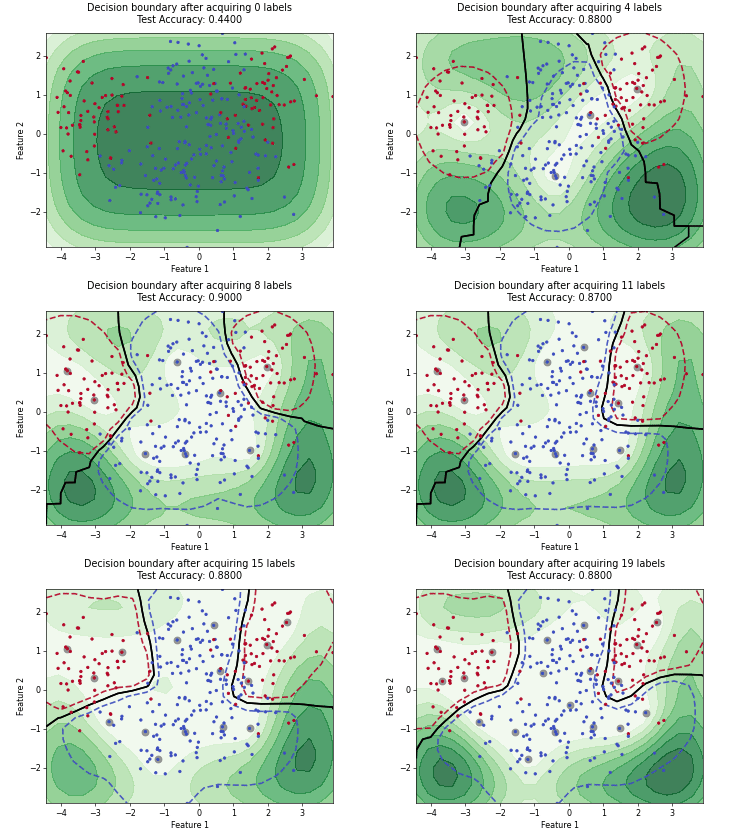
SingleAnnotatorPoolQueryStrategyThis class implements the MaxHerding query strategy [1], which greedily selects batch_size unlabeled samples that most increase a smooth, kernel-based coverage objective in embedding space, accounting for the already labeled set. The objective promotes representativeness and diversity via kernel similarity. Originally, this query strategy was only proposed for classification. Originally, this query strategy was only proposed for classification tasks. Nevertheless, this implementation is task-agnostic such that it can handle class labels, numerical targets, and multilabel targets represented by a two-dimensional y.
- Parameters:
- normalize_samplesbool, default=True
Flag whether to normalize the samples to have unit length.
- metricstr or callable, default=None
The metric must be None or a valid kernel as defined by the function sklearn.metrics.pairwise.pairwise_kernels.
- metric_dictdict, default=None
Any further parameters that should be passed directly to the kernel function sklearn.metrics.pairwise.pairwise_kernels.
- missing_labelscalar or string or np.nan or None, default=np.nan
Value to represent a missing label.
- random_stateNone or int or np.random.RandomState, default=None
The random state to use.
- target_type“auto” or “single-output” or “multi-label”, default=”auto”
Declared target structure. Automatic resolution accepts only unambiguous one-dimensional targets; two-dimensional multi-label targets must be declared explicitly.
References
[1]Bae, Wonho, Junhyug Noh, and Danica J. Sutherland. “Generalized Coverage for More Robust Low-Budget Active Learning.” In Eur. Conf. Comput. Vis. 2024.
Methods
query(X, y[, candidates, batch_size, ...])Determines for which candidate samples labels are to be queried.
Get metadata routing of this object.
get_params([deep])Get parameters for this estimator.
set_params(**params)Set the parameters of this estimator.
- MaxHerding.query(X, y, candidates=None, batch_size=1, return_utilities=False)[source]#
Determines for which candidate samples labels are to be queried.
- Parameters:
- Xarray-like of shape (n_samples, n_features)
Training data set, usually complete, i.e., including the labeled and unlabeled samples.
- yarray-like of shape (n_samples,) or (n_samples, n_outputs)
Labels of the training data set (possibly including unlabeled ones indicated by self.missing_label). If y is two-dimensional, a row y[i] must either contain only observed labels or only missing_label values, i.e., no mixing within a row.
- candidatesNone or array-like of shape (n_candidates,), dtype=int or array-like of shape (n_candidates, n_features), default=None
If candidates is None, the unlabeled samples from (X,y) are considered as candidates.
If candidates is of shape (n_candidates,) and of type int, candidates is considered as the indices of the samples in (X,y).
If candidates is of shape (n_candidates, n_features), the candidate samples are directly given in candidates (not necessarily contained in X).
- batch_sizeint, default=1
The number of samples to be selected in one AL cycle.
- return_utilitiesbool, default=False
If True, also return the utilities based on the query strategy.
- Returns:
- query_indicesnumpy.ndarray of shape (batch_size,)
The query indices indicate for which candidate sample a label is to be queried, e.g., query_indices[0] indicates the first selected sample.
If candidates is None or of shape (n_candidates,), the indexing refers to the samples in X.
If candidates is of shape (n_candidates, n_features), the indexing refers to the samples in candidates.
- utilitiesnumpy.ndarray of shape (batch_size, n_samples) or numpy.ndarray of shape (batch_size, n_candidates)
The utilities of samples after each selected sample of the batch, e.g., utilities[0] indicates the utilities used for selecting the first sample (with index query_indices[0]) of the batch. Utilities for labeled samples will be set to np.nan.
If candidates is None or of shape (n_candidates,), the indexing refers to the samples in X.
If candidates is of shape (n_candidates, n_features), the indexing refers to the samples in candidates.
- MaxHerding.get_metadata_routing()#
Get metadata routing of this object.
Please check User Guide on how the routing mechanism works.
- Returns:
- routingMetadataRequest
A
MetadataRequestencapsulating routing information.
- MaxHerding.get_params(deep=True)#
Get parameters for this estimator.
- Parameters:
- deepbool, default=True
If True, will return the parameters for this estimator and contained subobjects that are estimators.
- Returns:
- paramsdict
Parameter names mapped to their values.
- MaxHerding.set_params(**params)#
Set the parameters of this estimator.
The method works on simple estimators as well as on nested objects (such as
Pipeline). The latter have parameters of the form<component>__<parameter>so that it’s possible to update each component of a nested object.- Parameters:
- **paramsdict
Estimator parameters.
- Returns:
- selfestimator instance
Estimator instance.