QueryByCommittee#
- class skactiveml.pool.QueryByCommittee(method='KL_divergence', eps=1e-07, sample_predictions_method_name=None, sample_predictions_dict=None, missing_label=nan, random_state=None)[source]#
Bases:
SingleAnnotatorPoolQueryStrategyQuery-by-Committee (QBC)
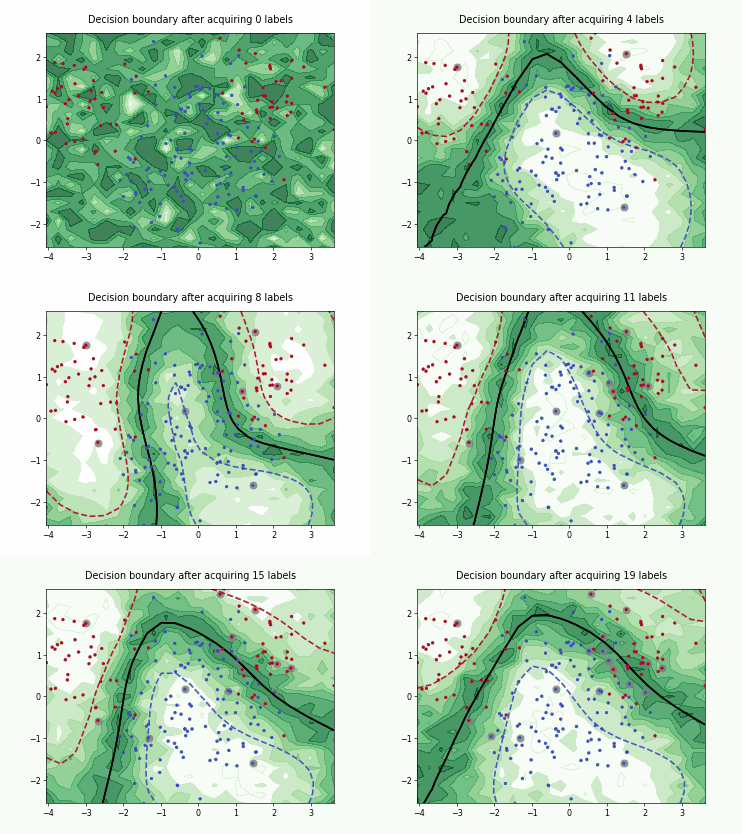
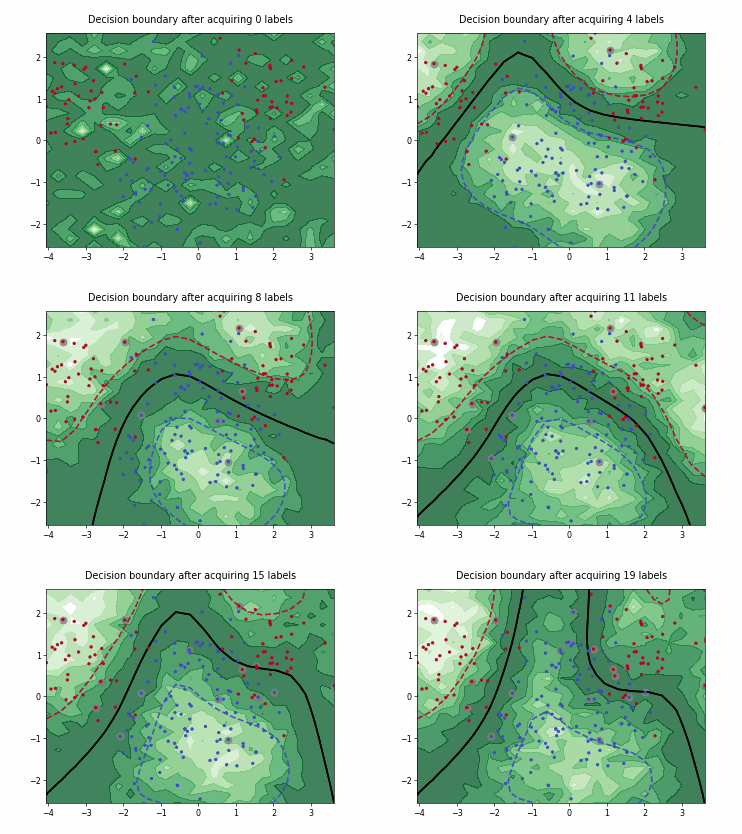
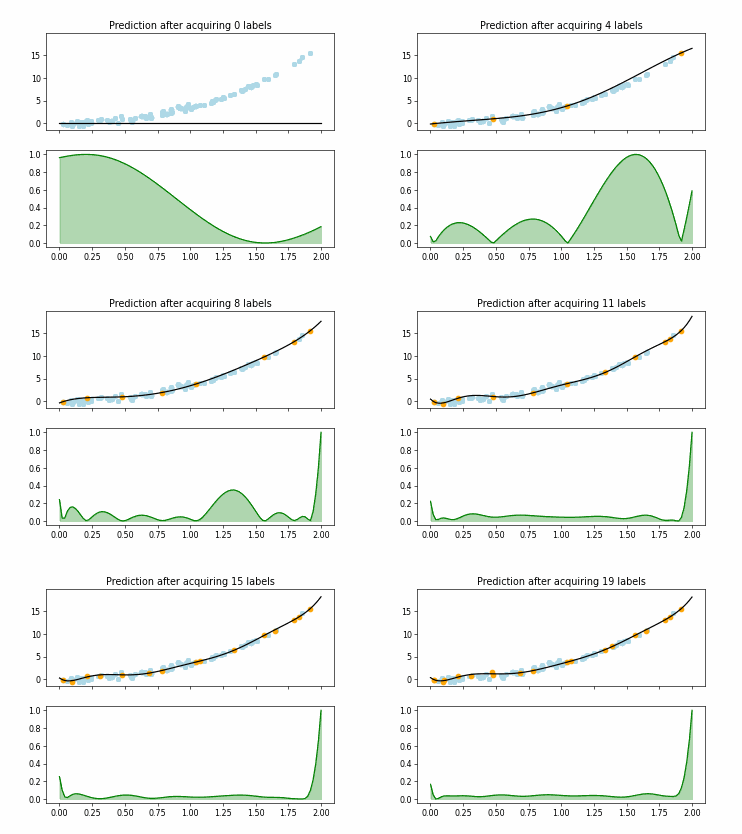
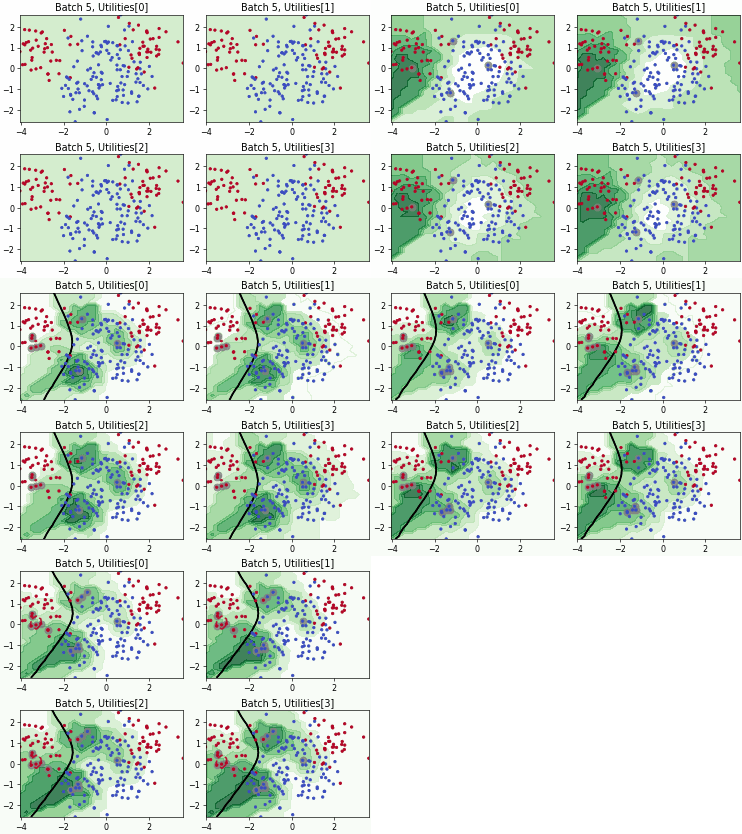
The Query-by-Committee (QBC) [1], [2], [3], [4], [5] strategy maintains a committee of models and selects unlabeled samples where the committee most disagrees, targeting epistemic uncertainty. In batch mode, it ranks points by a disagreement score and takes the top batch_size samples. There are multiple variants to measure the disagreement:
KL-divergence disagreement (classification). For each model, compute the Kullback–Leibler divergence between its predictive distribution and the committee average and average across models. Larger values indicate stronger distributional disagreement.
Vote entropy (classification). Each model votes for a class, the entropy of the vote histogram measures disagreement, and higher entropy is preferred.
Variation ratios (classification). One minus the fraction of votes for the modal class measures lack of consensus, and higher values are preferred.
Empirical variance (regression). The variance of the committee’s real-valued predictions quantifies disagreement, and higher variance is preferred.
- Parameters:
- method“KL_divergence” or “vote_entropy” or “variation_ratios, default=’KL_divergence’
The method to calculate the disagreement in the case of classification. ‘KL_divergence’, ‘vote_entropy’, and ‘variation_ratios’ are possible. In the case of regression, this parameter is ignored and the empirical variance is used.
- epsfloat > 0, default=1e-7
Minimum probability threshold to compute log-probabilities (only relevant for method=’KL_divergence’).
- sample_predictions_method_namestr, default=None
Certain estimators may offer methods enabling to construct a committee by sampling predictions of committee members. This parameter is to indicate the name of such a method.
If sample_predictions_method_name=None no sampling is performed.
If sample_predictions_method_name is not None and in the case of classification, the method is expected to take samples of the shape (n_samples, …) as input and to output probabilities of the shape (n_members, n_samples, n_classes), e.g., sample_proba in skactiveml.base.ClassFrequencyEstimator.
If sample_predictions_method_name is not None and in the case of regression, the method is expected to take samples of the shape (n_samples, …) as input and to output numerical values of the shape (n_members, n_samples), e.g., sample_y in sklearn.gaussian_process.GaussianProcessRegressor.
- sample_predictions_dictdict, default=None
Parameters (excluding the samples) that are passed to the method with the name sample_predictions_method_name.
This parameter must be None, if sample_predictions_method_name is None.
Otherwise, it may be used to define the number of sampled members, e.g., by defining n_samples as parameter to the method sample_proba of skactiveml.base.ClassFrequencyEstimator or sample_y of sklearn.gaussian_process.GaussianProcessRegressor.
- missing_labelscalar or string or np.nan or None, default=np.nan
Value to represent a missing label.
- random_stateint or np.random.RandomState or None, default=None
The random state to use.
References
[1]H. S. Seung, M. Opper, and H. Sompolinsky. Query by Committee. In Annu. Workshop Comput. Learn. Theory., pages 287–294, 1992.
[2]A. K. McCallum and K. Nigamy. Employing EM and Pool-Based Active Learning for Text Classification. In Int. Conf. Mach. Learn., pages 359–367, 1998.
[3]S. P. Engelson and I. Dagan. Minimizing Manual Annotation Cost in Supervised Training from Corpora. In Annu. Meet. Assoc. Comput. Linguist., pages 319–326, 1996.
[4]R. Burbidge, J. J. Rowland, and R. D. King. Active Learning for Regression Based on Query by Committee. In Intell. Data Eng. Autom. Learn., pages 209–218, 2007.
[5]W. H. Beluch, T. Genewein, A. Nürnberger, and J. M. Köhler. The Power of Ensembles for Active Learning in Image Classification. In IEEE/CVF Conf. Comput. Vis. Pattern Recognit., pages 9368–9377, 2018.
Methods
Get metadata routing of this object.
get_params([deep])Get parameters for this estimator.
query(X, y, ensemble[, fit_ensemble, ...])Determines for which candidate samples labels are to be queried.
set_params(**params)Set the parameters of this estimator.
- get_metadata_routing()#
Get metadata routing of this object.
Please check User Guide on how the routing mechanism works.
- Returns:
- routingMetadataRequest
A
MetadataRequestencapsulating routing information.
- get_params(deep=True)#
Get parameters for this estimator.
- Parameters:
- deepbool, default=True
If True, will return the parameters for this estimator and contained subobjects that are estimators.
- Returns:
- paramsdict
Parameter names mapped to their values.
- query(X, y, ensemble, fit_ensemble=True, sample_weight=None, candidates=None, batch_size=1, return_utilities=False)[source]#
Determines for which candidate samples labels are to be queried.
- Parameters:
- Xarray-like of shape (n_samples, n_features)
Training data set, usually complete, i.e., including the labeled and unlabeled samples.
- yarray-like of shape (n_samples,)
Labels of the training data set (possibly including unlabeled ones indicated by self.missing_label.)
- ensemblearray-like of SkactivemlClassifier or array-like of SkactivemlRegressor or SkactivemlClassifier or SkactivemlRegressor
If ensemble is a SkactivemlClassifier or a SkactivemlRegressor and has n_estimators plus estimators_ after fitting as attributes, its estimators will be used as committee.
If ensemble is array-like, each element of this list must be SkactivemlClassifier or a SkactivemlRegressor and will be used as committee member.
If ensemble is a SkactivemlClassifier or a SkactivemlRegressor and implements a method with the name sample_predictions_method_name, this method is used to sample predictions of committee members.
- fit_ensemblebool, default=True
Defines whether the ensemble should be fitted on X, y, and sample_weight.
- sample_weight: array-like of shape (n_samples,), default=None
Weights of training samples in X.
- candidatesNone or array-like of shape (n_candidates), dtype=int or array-like of shape (n_candidates, n_features), default=None
If candidates is None, the unlabeled samples from (X,y) are considered as candidates.
If candidates is of shape (n_candidates,) and of type int, candidates is considered as the indices of the samples in (X,y).
If candidates is of shape (n_candidates, …), the candidate samples are directly given in candidates (not necessarily contained in X). This is not supported by all query strategies.
- batch_sizeint, default=1
The number of samples to be selected in one AL cycle.
- return_utilitiesbool, default=False
If true, also return the utilities based on the query strategy.
- Returns:
- query_indicesnumpy.ndarray of shape (batch_size)
The query_indices indicate for which candidate sample a label is to queried, e.g., query_indices[0] indicates the first selected sample.
If candidates is None or of shape (n_candidates,), the indexing refers to the samples in X.
If candidates is of shape (n_candidates, n_features), the indexing refers to the samples in candidates.
- utilitiesnumpy.ndarray of shape (batch_size, n_samples) or numpy.ndarray of shape (batch_size, n_candidates)
The utilities of samples after each selected sample of the batch, e.g., utilities[0] indicates the utilities used for selecting the first sample (with index query_indices[0]) of the batch. Utilities for labeled samples will be set to np.nan.
If candidates is None or of shape (n_candidates,), the indexing refers to the samples in X.
If candidates is of shape (n_candidates, n_features), the indexing refers to the samples in candidates.
- set_params(**params)#
Set the parameters of this estimator.
The method works on simple estimators as well as on nested objects (such as
Pipeline). The latter have parameters of the form<component>__<parameter>so that it’s possible to update each component of a nested object.- Parameters:
- **paramsdict
Estimator parameters.
- Returns:
- selfestimator instance
Estimator instance.
Examples using skactiveml.pool.QueryByCommittee#
Batch Bayesian Active Learning by Disagreement (BatchBALD)
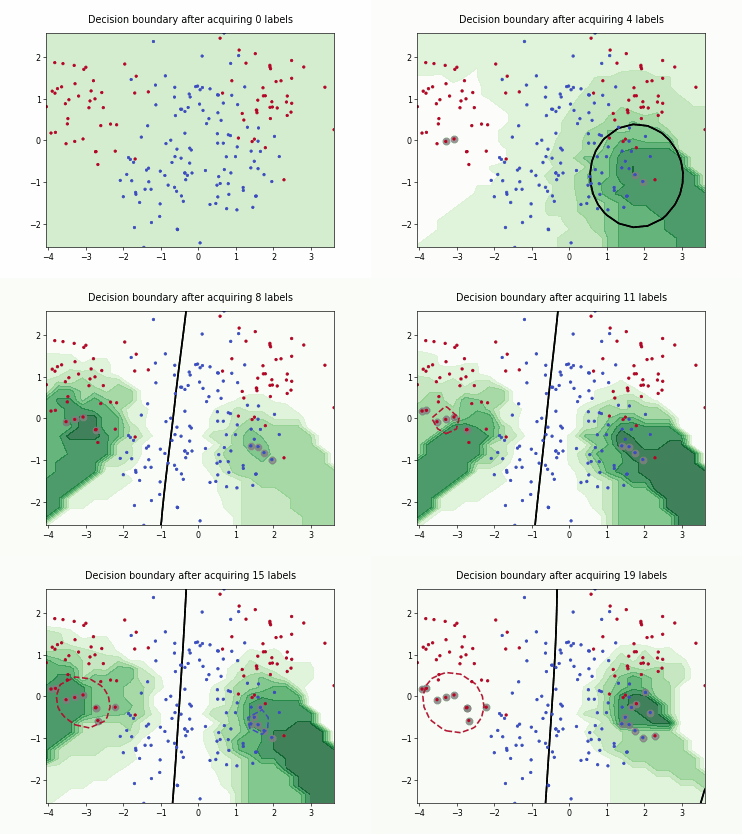
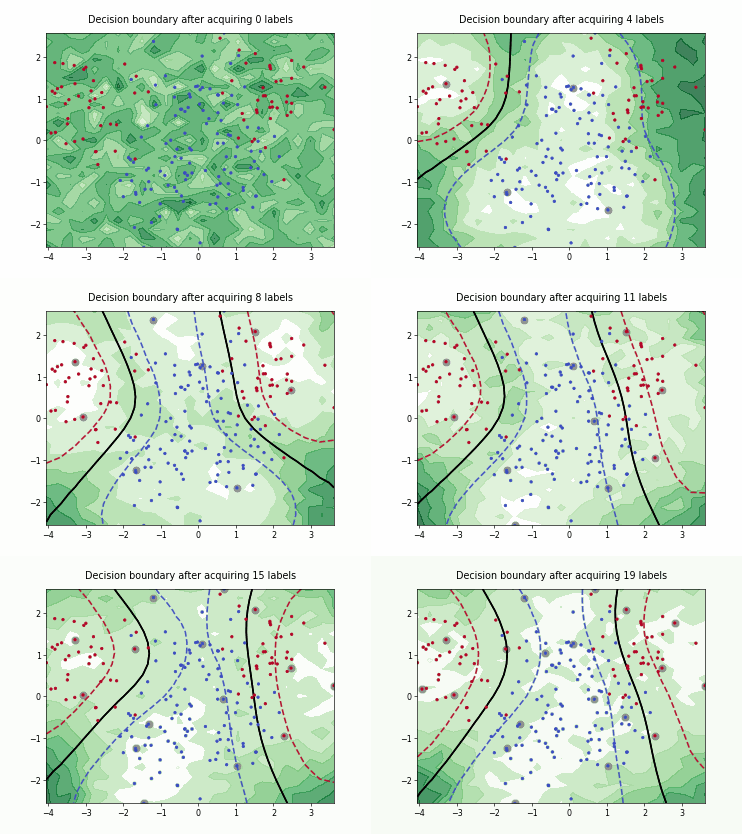
Query-by-Committee (QBC) with Kullback-Leibler Divergence